The Executive Vice President for Statewide Campus’s Award for Research Excellence is given annually to a WSU Vancouver faculty member whose research quality and quantity are exemplary, and whose work has had a positive influence on the broader community. It is the university’s highest research honor.
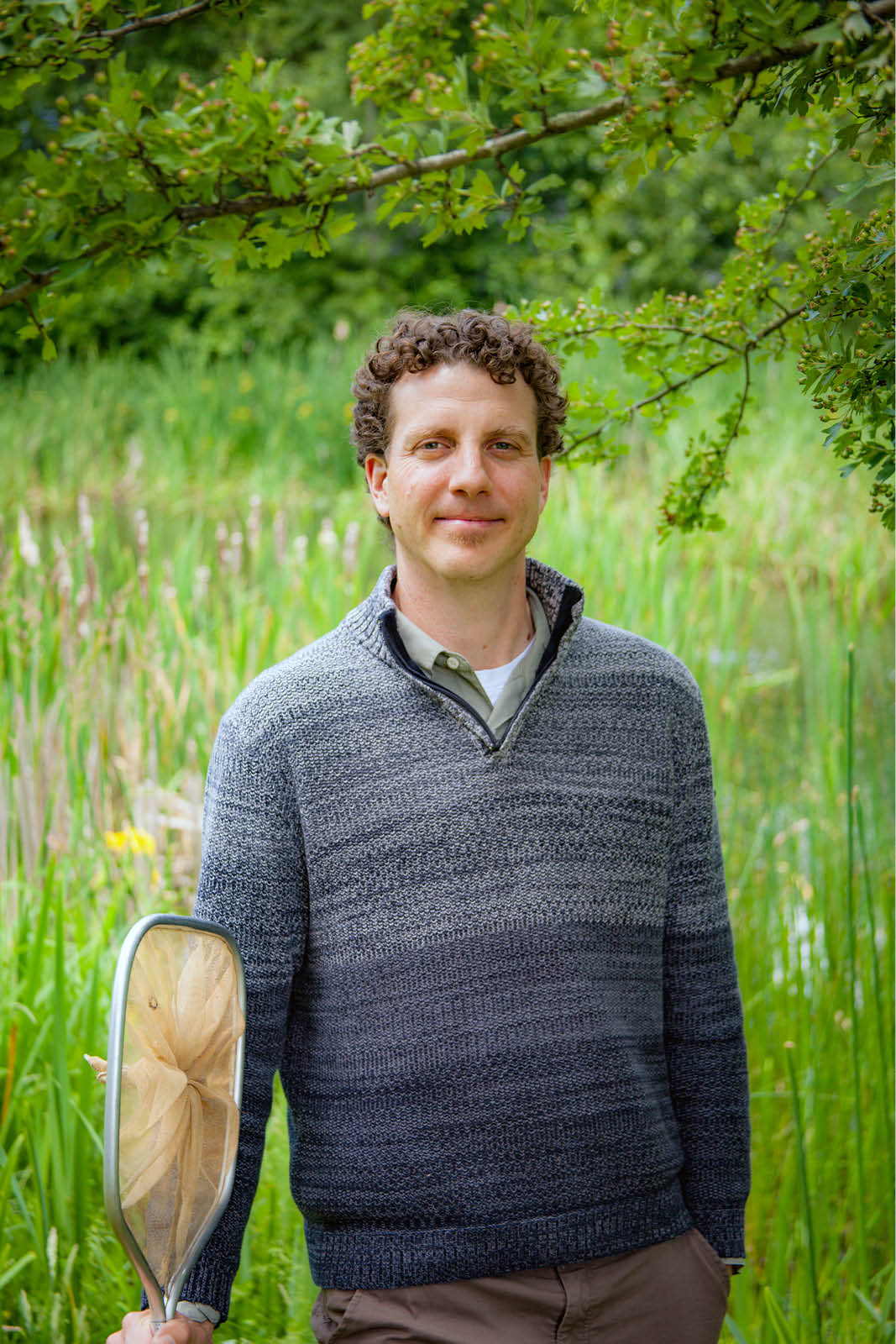
Jonah Piovia-Scott
Associate Professor in the College of Arts and Sciences
Jonah Piovia-Scott, associate professor in the School of Biological Sciences, is an internationally recognized ecologist whose research advances biodiversity conservation while helping communities respond to environmental change.
Read Full
Since joining WSU Vancouver in 2015, Piovia-Scott has built a highly productive research program focused on two of the most urgent challenges facing ecosystems worldwide: emerging wildlife diseases and climate change. His work combines rigorous science with practical solutions that support conservation practitioners and policymakers.
Piovia-Scott has published 57 peer-reviewed papers and book chapters, including four in some of the world’s most prestigious scientific journals—Proceedings of the National Academy of Sciences, Science and Nature Communications. His research also appears in leading journals in ecology and conservation, including Ecology Letters, Ecology and Biological Conservation.
Much of that work is collaborative and driven by student researchers. Seventeen of Piovia-Scott’s publications feature a student or postdoctoral mentee as the lead author. Since 2021 alone, his lab has produced 24 peer-reviewed publications and presented its research 26 times at regional, national and international scientific conferences.
His research on amphibian diseases has helped scientists better understand how pathogens affect wildlife populations and how targeted field treatments may help protect threatened species. Amphibians are the most threatened group of vertebrates on Earth, and Piovia-Scott’s work contributes to global efforts to understand and address this crisis. Through leadership roles on international wildlife disease task forces, he works with researchers, government agencies and conservation organizations to translate scientific findings into action.
Piovia-Scott also studies how beavers can help ecosystems adapt to climate change. His research shows that beaver-driven habitat changes can improve water systems, support wildlife and strengthen ecosystem resilience. He works closely with conservation practitioners and policymakers to apply these findings in restoration projects and environmental policy, including sharing research with the Washington State Senate Committee on Agriculture and Natural Resources.
External funding has supported the continued growth of Piovia-Scott’s research program. Since arriving at WSU, he has helped secure $2.9 million in external grants, including funding from the National Science Foundation, U.S. Forest Service, U.S. Fish and Wildlife Service and several state wildlife agencies and foundations. In 2025, he led a $1.6 million joint grant from the National Science Foundation and the Paul Allen Family Foundation focused on advancing conservation science and practice.
Piovia-Scott’s work also strengthens WSU Vancouver’s mission to provide meaningful research opportunities for students. His lab has trained dozens of undergraduate researchers while building partnerships with regional tribes, conservation organizations and industry to address real-world environmental challenges.
Past award recipients
| Academic Year | Recipient | Department/College |
|---|---|---|
| 2024 – 2025 | Kristin Lesseig | — |
| 2023 – 2024 | Deepti Singh | — |
| 2022 – 2023 | Deepti Singh | — |
| 2021 – 2022 | Ed Hagen | — |
| 2020 – 2021 | Dave Kim | Mechanical Engineering |
| 2019 – 2020 | Marcelo Diversi | Human Development |
| 2018 – 2019 | Bala Krishnamoorthy | Mathematics |
| 2017 – 2018 | Cheryl Schultz | Biological Sciences |
| 2016 – 2017 | Candice Goucher | History |
| 2015 – 2016 | John Harrison | School of the Environment |
| 2014 – 2015 | Tahira Probst | Psychology |
| 2013 – 2014 | Thomas Tripp | Business |
| 2012 – 2013 | Jane Lanigan | Human Development |
| 2011 – 2012 | Christine Portfors | Neuroscience |
| 2010 – 2011 | Stephen Kucer | Education |
| 2009 – 2010 | WenZhan Song | Engineering |
| 2008 – 2009 | Joe Cote | Business |
| 2007 – 2008 | Tamara Holmund Nelson | Education |
| 2006 – 2007 | Amy Wharton | Sociology |
| 2005 – 2006 | Barry Hewlett | Anthropology |
| 2004 – 2005 | Clayton Mosher | Sociology |
| 2003 – 2004 | Michael Morgan | Psychology |
| 2002 – 2003 | John Bishop | Biology |
| 2001 – 2002 | Susan Finley | Education |
| 2000 – 2001 | Hakan Gurocak | Engineering |
| 1999 – 2000 | Sally Hacker | Biology |
| 1998 – 1999 | Ed Brook | Geology |
| 1997 – 1998 | Meridith Newman | Public Affairs |
| 1996 – 1997 | Sue Peabody | History |
| 1995 – 1996 | Charles ‘Cap’ Peck | Education |
| 1994 – 1995 | Carol Siegel | English |
| 1993 – 1994 | Jerry Goodstein | Business |